When your clients ask AI who to trust, your firm should be the name it gives.
Your future clients ask ChatGPT for “the best estate planning attorney in my city.” They ask Perplexity to compare concierge medical practices. They trust Google’s AI Overview before page one. Traditional SEO alone no longer decides who gets found. AI does. We make your firm easy for AI to find, trust, and cite by name.

The invisible architecture behind who AI recommends
Start here. This shows what AI engines actually read when they decide which firms to name, and why so many good firms are invisible to it.
Ready to go deeper? The AEO Formula is the schema, entity, and FAQ playbook answer engines extract from.
Get the AEO Formula · $4.97How we run every AI Visibility engagement
Build the entity clarity, schema, and answer-ready content AI engines read, so your firm is legible and citable from the first page.
Scope every move against your Bar advertising, HIPAA, or SEC constraints, so visibility never comes at the cost of a rule.
Track citation frequency, position, and language across ChatGPT, Perplexity, and Google AI month over month, so progress is visible.
One discipline.
Five surfaces to win.
AI assistants, search engines, and local map results each pick firms for different reasons. A full AI Visibility engagement covers all five. Each card below shows how.
Sometimes framed as SEO, GEO, AEO, and AIO (AI Optimization). Same work, different labels. Read the GEO + AEO + LLMO whitepaper for the full framework.

ChatGPT · Perplexity · Gemini · Claude
Generative Engine Optimization (GEO)
Make your firm the name generative engines recommend.
Generative engines don't rank pages. They compose answers, and they only name firms they can confidently identify and trust. GEO builds that confidence. It keeps the details AI engines read about your firm consistent everywhere you appear. It maps JSON-LD schema to the types the models were trained on. And it builds the third-party citation footprint that makes an AI comfortable saying your name.
- Entity disambiguation, consistent name, address, practice areas, and key people across the web
- JSON-LD schema architecture (Organization, LocalBusiness, Person, FAQPage + vertical types)
- Server-side rendered HTML so AI crawlers can read every page (many run no JavaScript, so a single-page site can hand them a blank page)
- Authoritative source placement, directories and publications AI models already trust
- Citation monitoring, which engines mention your firm, for which prompts
- Topical density mapping, interlinked pages that establish authority per practice area
- Freshness signals, visible publish and update dates that models reward
Full engagements cover all five pillars on a 90-day term.
Ask about this
Google AI Overviews · Featured snippets · People Also Ask · Voice
Answer Engine Optimization (AEO)
Win the answer box before the click ever happens.
Answer engines extract; they don't interpret charitably. AEO restructures your expertise into the exact question-and-answer formats those systems lift from. That means FAQ blocks with FAQPage schema, comparison content for "X vs Y" queries, and locally anchored authority pages that answer exactly what a prospect types.
- FAQ content engineered from real prospect questions, marked up with FAQPage schema
- Google AI Overview and featured-snippet targeting per practice area
- People Also Ask coverage mapping
- Comparison and "best of" content for evaluation-stage queries
- Voice-search phrasing (natural-language question forms)
- Extractability audits, can an answer engine lift your answer verbatim?
Full engagements cover all five pillars on a 90-day term.
Ask about this
Credentialed authorship · Depth · Off-site authority
Large Language Model Optimization (LLMO)
Be the name AI is confident enough to recommend.
Structure gets you read. Authority gets you recommended. LLMO builds the credibility signals large language models are trained to weight: content attributed to named, credentialed professionals, real depth on the topics you want to be known for, freshness that signals you are still the authority, and the off-site citations, reviews, and affiliations that no amount of on-page work can fake. We tell every client the same truth. The build makes you citable, and off-site authority is what turns citable into cited.
- Named, credentialed authorship on every substantive page
- Topic-cluster depth that signals real expertise, not thin content
- Freshness and update cadence on your core authority pages
- Internal linking that maps the breadth of your expertise
- Third-party citations, reviews, and recognized affiliations
- Original data and benchmarks, your own numbers or outcomes that engines cite back to you, not to a third party
- A content credibility scorecard scored against six authority signals
Full engagements cover all five pillars on a 90-day term.
Ask about this
Technical SEO · Content · Bilingual EN/ES
AI-Powered SEO
SEO that feeds the AI layer instead of competing with it.
Google still sends the traffic that generative engines learn from. AI-powered SEO runs the classic discipline with modern tooling: AI-assisted keyword and intent research, competitive gap analysis, and programmatic local landing pages. A senior editor reviews everything. AI-generated slop is exactly what both Google and generative engines are learning to discount.
- AI-assisted keyword, intent, and competitive gap research
- Technical SEO, Core Web Vitals, crawlability, index hygiene
- Programmatic local landing pages tailored to your service area
- Content production with senior editorial review, no unreviewed AI copy
- Bilingual English/Spanish optimization for South Florida and Latin American markets
- Revenue attribution, inquiries and consultations sourced from organic and AI search
Full engagements cover all five pillars on a 90-day term.
Ask about this
Google Business Profile · Consistent business listings · Steady reviews
Local AI Dominance
Own your neighborhood in both indexes.
When a prospect asks "best [specialty] near me," two systems answer: the Google map pack and the AI engines. Both lean heavily on local signals. Those are Google Business Profile completeness, consistent NAP citations, review velocity and recency, and neighborhood-level content. We build all four, so your firm owns the block it actually serves.
- Google Business Profile optimization and category strategy
- NAP citation consistency across directories and data aggregators
- Review velocity strategy, automated, compliance-aware review generation
- Neighborhood-level content, Coral Gables, Brickell, Coconut Grove, South Miami, Pinecrest
- Local schema (areaServed, GeoCoordinates) aligned with your service area
- Map-pack + AI-answer tracking for your priority local queries
Full engagements cover all five pillars on a 90-day term.
Ask about thisSearch stopped being a race to page one. It is four layers now.
The old goal was a rank on a list of ten links, measured in traffic. The new goal is to be the source AI engines find, trust, and cite by name. Classic SEO is still the foundation. Four layers now sit on top of it, and AI Visibility builds all four.
GEO
Generative Engine Optimization
Being cited and recommended inside generative answers, in ChatGPT, Gemini, and Perplexity. Also called LLMO.
AEO
Answer Engine Optimization
Being the source behind AI summaries and overviews, such as Google AI Overviews.
AIO
AI Integration Optimization
Structuring your data, schema, and feeds so AI tools and agents can read and use them directly, not just render them for a human.
SXO
Search Experience Optimization
Aligning the on-page experience, trust signals, and conversion path with what the visitor actually intends to do.
SEO gets you readable. These four decide whether the engines find you, trust you, and put your name forward. The end goal is no longer page one. It is to be cited, trusted, and chosen.
Two halves, just like SEO. We build both.
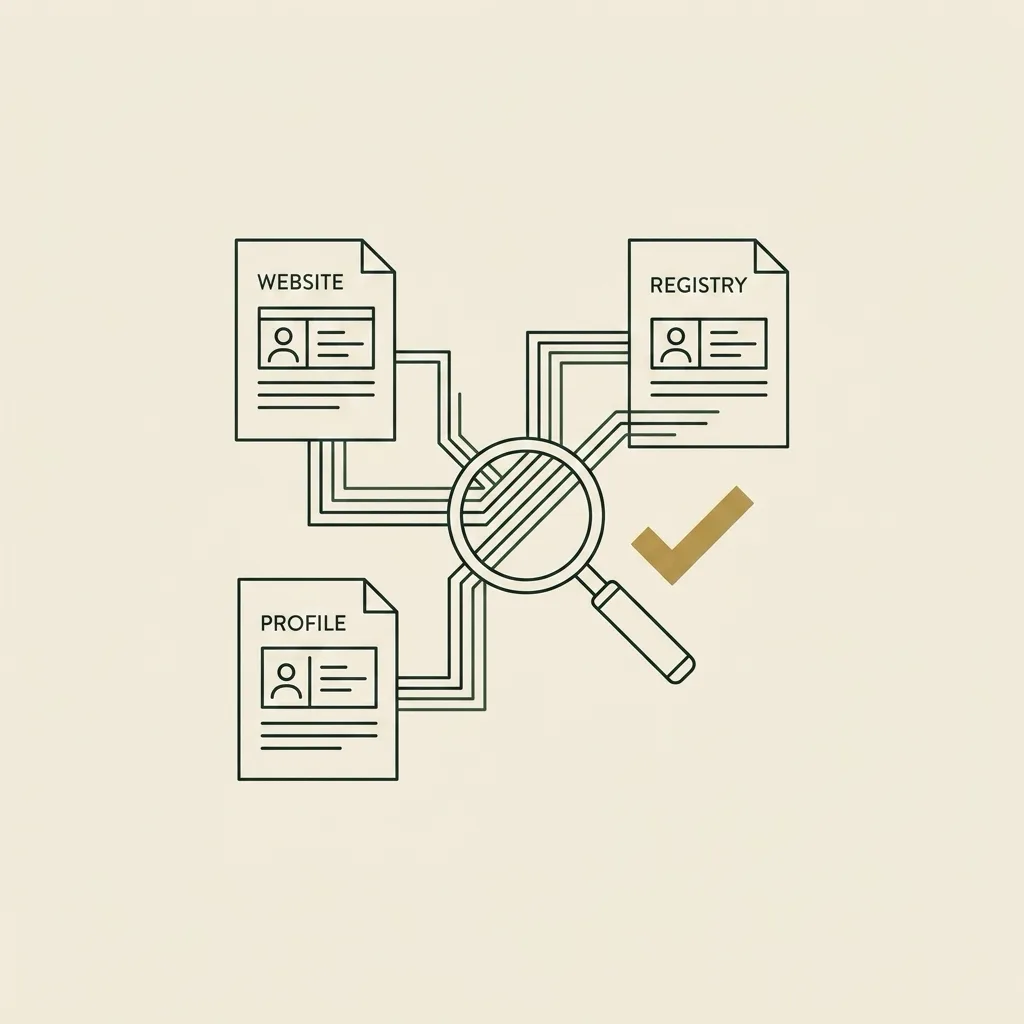
Classic SEO always had two sides: the work on your own pages, and the authority you earn across the rest of the web. AI Visibility is the same idea, rebuilt for the engines that now answer your clients. On-page is fast. Off-page takes the full 90 days, because it depends on how quickly directories, profiles, and sources corroborate you, and that runs on schedules no one controls.
On-page: your own site
Live in the first weeks
The schema, entity graph, FAQ layer, and metadata on your pages. This is the foundation, and it ships early. It makes your firm legible to an AI engine.
- JSON-LD schema and entity clarity
- Answer-ready FAQ and content structure
- Metadata and internal linking
Off-page: the rest of the web
Builds across the 90-day term
The citations, directory profiles, and authority signals that corroborate you everywhere else. An engine cross-checks these before it names you, so this runs the full 90 days. Verification and propagation cannot be rushed.
- Google Business Profile and directory build
- NAP consistency and entity corroboration
- Citation and authority placements
A technically perfect site can still go unnamed if the rest of the web does not back it up. That is why we do both, and why the off-page half sets the pace.
A 90-day engagement, in three phases.
You see a 40-query baseline in week one and a share-of-voice report at Day 30, 60, and 90. No black box, no open-ended retainer.
Foundation
Measure the truth, fix the signals.
- Prompt and query mapping
- A 40-query Day 0 baseline across ChatGPT, Perplexity, Gemini, and Google AI Overviews
- Competitor and citation analysis
- Entity audit and JSON-LD schema architecture
- Google Business Profile and directory completion
What you see
Your Day 0 baseline across 40 prospect queries, the prompt map, and biggest gaps.
Optimization
Become the answer-ready, citable option.
- Homepage and service-page optimization
- FAQ and answer blocks in real question formats
- Entity clarity and internal linking
- Location and vertical pages
- AI-powered SEO on the classic surface
What you see
A Day 30 share-of-voice report: how often you are named versus competitors, per engine.
Scale and Validation
Build authority, prove the movement.
- A named citation and directory build across Google Business Profile and field directories
- Bylined placement in indexed publications and field directories
- Local and profile consistency reinforcement
- Before-and-after measurement
- Next-quarter roadmap
What you see
A Day 90 before-and-after, share-of-voice movement, and full handoff.
Everything a 90-day engagement ships.
Grouped by the four workstreams that move a firm from invisible to cited.
Foundation
- Entity audit across every clarity surface
- JSON-LD schema (Organization, LocalBusiness, Person, FAQPage, vertical type)
- Google Business Profile and directory completion
Content
- Answer-ready FAQ blocks in real question formats
- Location and service pages
- AI-powered SEO with senior editorial review
Authority
- Bylined placement in indexed publications
- Field-specific directory profiles
- Source and citation building
Measurement
- A 40-query baseline across ChatGPT, Perplexity, Gemini, and Google AI Overviews
- Share-of-voice reporting at Day 30, 60, and 90, you versus named competitors
- Day 90 handoff: full query set, baseline data, and profile credentials
Senior-built, and proven on live firms.
This is not a template service. It is founder-led, scoped against your field’s rules, and measured.
AI visibility score
A recent regulated healthcare practice we built shipped with complete schema, answer-ready FAQ, and a linked Google Business Profile, scoring 76 of 100 on AI visibility at launch.
See the workFounder-led
Brandon Aday brings 20-plus years across engineering and growth. He reviews and signs off on the work, so the strategy and the code come from the same senior hand.
Meet BrandonBuilt for regulated fields
Every engagement is scoped against your rules: Bar advertising rules for law firms, HIPAA-aware content for medical practices, and SEC marketing limits for wealth managers. Bilingual English and Spanish when you need it.
Industries we serveDiagnose before you spend.
The ladder is deliberate: learn and diagnose for free, then climb only as far as you need. Each rung below $497 stands alone as its own deliverable. The $497 Schema in a Week credits in full toward the plan, so you never pay twice for the same work.
Learn & Self-Assess
Free
AI Visibility Masterclass
A free 30-minute masterclass on why AI now decides who your clients hire, and the moves that get your firm found, trusted, and named. Coming soon on learn.adayinteractive.com; register to be first to watch.
Coming SoonFree
AI Visibility Scorecard
A 10-minute self-audit: 5 tests you run in ChatGPT and Perplexity. You keep 2 PDFs: the Scorecard, and the full Mastering AI Search Visibility whitepaper and LLMO scorecard.
See Where You Stand$4.97
The AEO Formula
The AEO Formula ebook: the schema, entity, and FAQ playbook answer engines extract from. You keep 3 PDFs: the ebook, plus the Scorecard and the whitepaper.
Get the EbookDiagnose & Execute
$14.97
AI Visibility (GEO) Audit
A scored, seven-area diagnostic of your live site with a branded PDF report and a 15‑min findings call with Brandon. Plus your full free library to keep.
Run my Audit$97
Founder-Led AI Growth Audit
A written 4-page remediation memo plus the AEO Step-by-Step mini-course and an invite to the monthly “Ask Brandon” group Zoom, where you get your questions answered live.
Book$497 · Done for you
Schema in a Week
We ship it: schema.org markup plus a FAQPage block on one URL of your site in 5 to 10 days. Credits in full toward the AI Visibility Intensive or the 90-day plan.
Start$1,950 · Founder-led day
AI Visibility Intensive
A multi-engine visibility baseline, citation and competitor review, and a crawler-access check, then entity, schema, and answer-first fixes shipped live, in one founder-led day. Written 90-day roadmap in 5 days, including the off-site authority plan. Credits toward the plan.
Applyfrom $5,000
90-Day Visibility Plan
The full done-for-you engagement: a 40-query baseline, then sequenced remediation across all five pillars, on-page and off-page, entity and schema architecture, an answer-first content and FAQ model, technical fixes, and citation and authority work, with share-of-voice reporting at Day 30, 60, and 90. The $5,000 floor is the focused scope; it scales with the size of your site and query set. After Day 90, ongoing work continues under a growth retainer.
Important disclosure AI assistants (ChatGPT, Perplexity, Gemini, Google AI Overviews, and others) independently determine which firms they cite. We can architect for citation, measure where you appear, and identify where you don’t. But no agency can guarantee specific AI outputs, citation frequency, or search rankings. All performance metrics are directional and reported transparently each month. Engagements with law firms are scoped to comply with applicable bar advertising rules (e.g., ABA Model Rules 7.1 to 7.3 and the rules of your jurisdiction). Healthcare engagements respect HIPAA and FTC guidance on professional advertising. We do not draft, send, or sign client communications without your firm’s review.
Built for your industry
See how this applies to your firm
Every vertical has its own page with a free diagnostic scan calibrated to its rules and its language.
One path, four stages
Where is your firm on the path?
Build the foundation. Become a firm AI can cite. Capture every lead. Then adopt AI with senior governance. Most firms enter at the stage that hurts, and each stage builds on the one before it.
Custom Web & SaaS
“Does your site earn trust and convert the visitors you already get?”
A site built under your firm's name, designed to grow with it.
Free build kit You are hereAI Visibility
“When a prospect asks ChatGPT who to trust, is your firm the answer?”
The firm AI engines recommend by name.
See what AI says about youAI Growth Systems
“How many leads slip away after hours or between follow-ups?”
Every lead captured, answered in under 60 seconds, and followed up.
Free Voice AI demoCustom AI & Fractional CAIO
“Is AI a governed strategy at your firm, or a set of experiments?”
AI adopted with senior ownership, governance, and a proprietary edge.
Readiness assessmentThe usual next step from here is Stage 3: AI Growth Systems. Not sure where you sit? Take the readiness assessment.
Is your firm the answer, or is your competitor?
Ask ChatGPT who it recommends for your specialty in your city. If the answer isn’t your firm, the gap is measurable, and closeable. Start with the audit or bring the results to a consultation.
or call 305-209-8453 · se habla español